

The buying journey nobody built for
Twenty-five years studying how customers discover, evaluate, trust, and buy across commerce and SaaS. Here is what AI-mediated buying looks like from the inside.
Topics
Design for AI-mediated discovery.
Make evaluation and trust visible.
Close the loop on purchase intent.
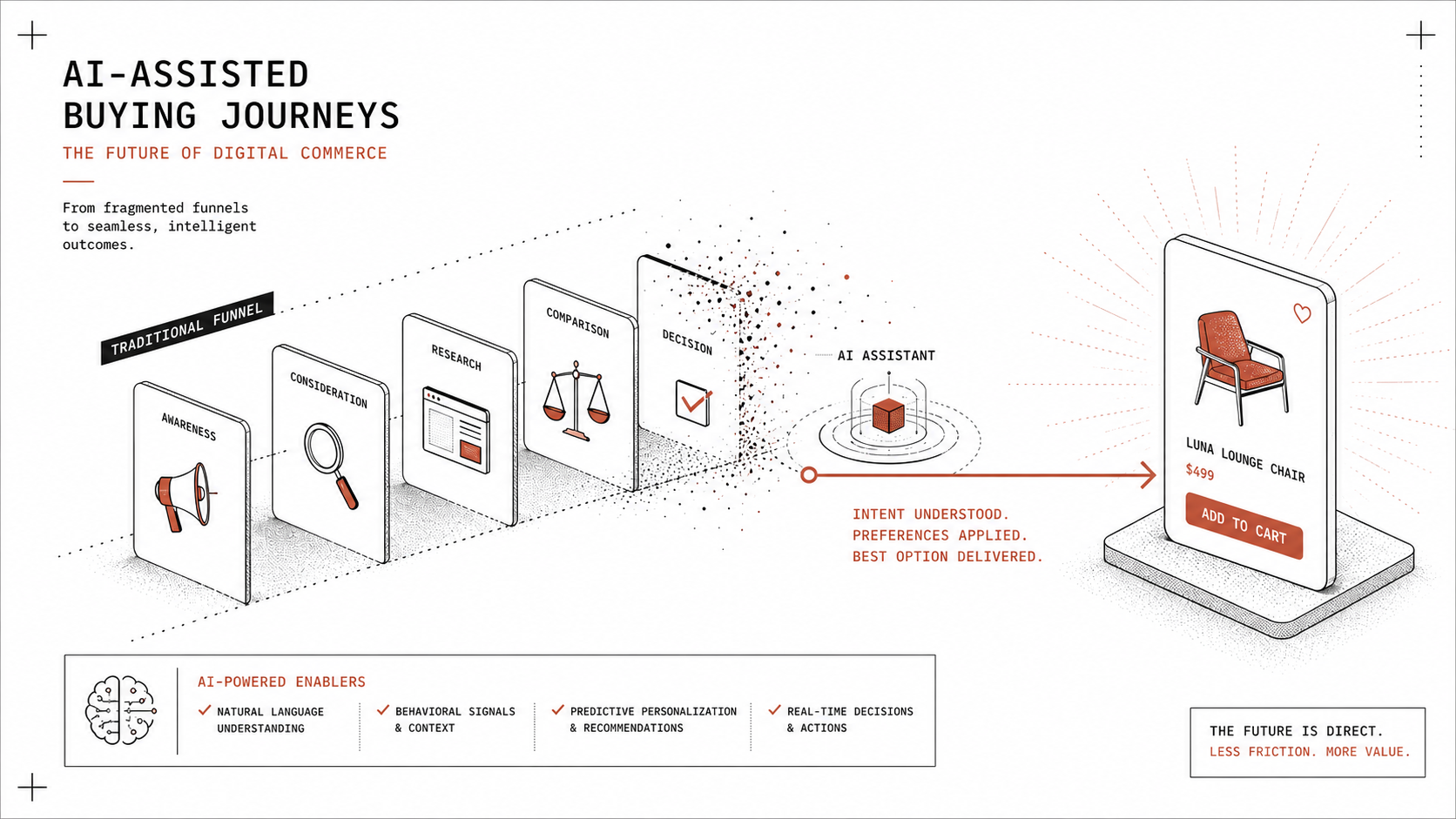
Table of Contents ▼
Introduction
I have spent most of my career trying to understand a deceptively simple question: why do people buy things? Not in the economic sense, but in the granular, behavioural, sometimes irrational sense. The way a customer reads a product page and decides within four seconds whether to keep scrolling. The way trust gets built or broken in the first 30 seconds of an onboarding flow.
That foundation, built across e-commerce, SaaS, and consumer behaviour, is why I find the current AI moment genuinely interesting rather than just technically novel. Because AI is not changing whether people buy things. It is changing the entire apparatus through which discovery, evaluation, and trust get established.
The funnel was always a simplification
The classic digital commerce funnel was never how customers experienced buying. It was how we instrumented our analysis of it. Real buying behaviour is messier, non-linear, and deeply contextual. Customers abandon, return, research laterally, ask friends, and sometimes just get distracted and come back three days later.
What the funnel did well was give organisations a shared language for measuring a journey too complex to manage otherwise. The problem is that language became a cage. Teams optimised for the funnel rather than the customer. UX became about reducing drop-off rather than building trust.
The companies that optimise hardest for the funnel often end up with the least trusted brands. The funnel measures transactions. It says nothing about whether customers feel good about what they bought.
AI-mediated commerce does not disrupt the funnel so much as reveal how incomplete it always was. When a customer delegates discovery and evaluation to an AI assistant, the funnel simply does not apply. There is no browse phase. There may not even be a product page visit. The AI surfaces a recommendation, and the customer decides, sometimes without a single marketing page in the loop.
What actually changes with AI intermediaries
The surface change is obvious: customers interact with AI assistants rather than websites. The deeper change is in what signals matter. The companies that show up well in AI recommendations share characteristics that have nothing to do with marketing:
- Structural clarity: Schema.org markup, clean pricing pages, documented integrations. If an AI cannot parse your value proposition in 30 seconds, you are invisible.
- Outcome specificity: “Industry-leading platform” is meaningless to an AI. “Reduces deployment time by 40%, verified across 847 reviews” is parseable, credible, and citable.
- Self-serve entry: If getting started requires a demo request, an agent will skip you. This is table stakes for AI-mediated distribution.
- Verified social proof: Third-party verification matters more in an AI context because the AI can weight recency, volume, and sentiment at speed.
What is interesting is that these characteristics are also just good product discipline. Stripe, Linear, Loom, Cal.com did not build for AI recommendation. They built for clarity. AI recommendation is a consequence of that discipline.
The design shift nobody is talking about clearly
| Old priority | New priority | Why it changed |
|---|---|---|
| Attention capture | Signal clarity | AI ignores persuasion, parses structure |
| Conversion funnel | Self-serve onboarding | Agents evaluate by attempting entry |
| Visual hierarchy | Information architecture | Machines read structure, not aesthetics |
| Brand narrative | Verifiable proof points | Claims need traceable sources |
| Navigation design | API and data accessibility | The site may not be the interface |
| SEO keywords | Semantic content structure | LLMs reason about intent, not keywords |
This does not make visual design irrelevant. Humans still make final decisions and want to trust what they are buying. But the sequence inverts. The AI narrows the field. The human validates emotionally. Design now works at step two, not step one.
The transparency paradox and the real opportunity
AI-mediated commerce should push markets toward greater transparency. The companies that win AI recommendations are those with the clearest, most verifiable, most self-serve propositions. Dark patterns, opacity, and obfuscation become competitive disadvantages.
The companies choosing radical clarity, public pricing, open roadmaps, published benchmarks, no sales calls required, are pre-adapting to an AI-mediated market where opaque competitors become increasingly invisible. That was a positioning choice that is now becoming a structural advantage.
The real opportunity is for organisations willing to treat their information architecture as a product. The way you structure your pricing page is a design decision with measurable competitive consequences. The specificity of your outcome claims is a trust-building mechanism with AI-era implications.
What I am watching in the next 18 months
- “AI-ready” becomes a product category. Structured data standards and machine-readable trust signals will become legitimate differentiators. Think HTTPS , once optional, then table stakes.
- Demo-gated evaluation dies. Any product requiring human interaction before a prospect can assess value will be filtered out of AI recommendation sets for mid-market buyers.
- Human-first vs. agent-first products split. Some products will be designed for direct human use. Others will be designed for AI orchestration on behalf of humans. These are different design problems.
- Outcome measurement becomes public currency. Companies who publish tracked metrics, not just testimonials, will compound their AI recommendation share over time.
The buying journey that most organisations were built around assumed a human browsing, reading, and deciding. That assumption is no longer safe. The organisations that adapt earliest are not just anticipating a new distribution channel. They are redesigning the competitive surface of their entire business.
That is not a UX project. It is a strategic one. But it starts with design.